Our vast resources are yet new; new only because architecture as “rebirth” (perennial Renaissance) has, after five centuries of decline, culminated in the imitation of imitations, seen in our Mrs. Plasterbuilt, Mrs. Gablemore, and Miss Flat-top American architecture. In general, and especially officially, our architecture is at long last completely significant of insignificance only. We do not longer have architecture. At least no buildings with integrity. We have only economic crimes in its name. No, our greatest buildings are not qualified as great art, my dear Mrs. Davies, although you do admire Washington.
If you will yet be patient for a little while—a scientist, Einstein, asked for three days to explain the far less pressing and practical matter of “Relativity”—we will take each of the five new resources in order, as with the five fingers of the hand. All are new integrities to be used if we will to make living easier and better today.
The first great integrity is a deeper, more intimate sense of reality in building than was ever pagan—that is to say, than was ever “Classic.” More human than was any building ever realized in the Christian Middle Ages. This is true although the thought that may ennoble it now has been living in civilization for more than twenty centuries back. Later it was innate in the simplicities of Jesus as it was organic 500 years earlier in the natural philosophy, Tao (The Way) of the Chinese philosopher, Laotze. But not only is the new architecture sound philosophy. It is poetry.
Said Ong Giao Ki, Chinese sage, “Poetry is the sound of the head.”
Well, like poetry, this sense of architecture is the sound of the “within.” We might call that “within,” the heart.
Architecture now becomes integral, the expression of a new-old reality: the livable interior space of the room itself. In integral architecture the room-space itself must come through. The room must be seen as architecture, or we have no architecture. We have no longer an outside as outside. We have no longer an outside and an inside as two separate things. Now the outside may come inside, and the inside may and does go outside. They are of each other. Form and function thus become one in design and execution if the nature of materials and method and purpose are all in unison.
This interior-space concept, the first broad integrity, is the first great resource. It is also true basis for general significance of form. Add to this for the sake of clarity that (although the general integration is implied in the first integrity) it is in the nature of any organic building to grow from its site, come out of the ground into the light—the ground itself held always as a component basic pied of the building itself. And then we have primarily the new ideal of building as organic. A building dignified as a tree in the midst of nature.
This new ideal for architecture is, as well, an adequate ideal for our general culture. In any final result there can be no separation between our architecture and our culture. Nor any separation of either from our happiness. Nor any separation from our work.
Thus in this rise of organic-integration you see the means to end the petty agglomerations miscalled civilization. By way of this old yet new and deeper sense of reality we may have a civilization. In this sense we now recognize and may declare by way of plan and building—the natural. Faith in the natural is the faith we now need to grow up on in this coming age of our culturally confused, backward twentieth century. But instead of “organic” we might well say “natural” building. Or we might say integral building.
So let us now consider the second of the five new resources: glass. This second resource is new and a “super-material” only because it holds such amazing means in modern life for awakened sensibilities. It amounts to a new qualification of life in itself. If known in ancient times glass would then and there have abolished the ancient architecture we know, and completely. This super-material glass as we now use it is a miracle. Air in air to keep air out or keep it in. Light itself in light, to diffuse or reflect, or refract light itself.
By means of glass, then, the first great integrity may find prime means of realization. Open reaches of the ground may enter as the building and the building interior may reach out and associate with these vistas of the ground. Ground and building will thus become more and more obvious as directly related to each other in openness and intimacy; not only as environment but also as a good pattern for the good life lived in the building. Realizing the benefits to human life of the far-reaching implications and effects of the first great integrity: let us call it the interior-space concept. This space interior realization is possible and it is desirable in all the vast variety of characteristic buildings needed by civilized life in our complex age.
By means of glass something of the freedom of our arboreal ancestors living in their trees becomes a likely precedent for freedom in twentieth century life, than the cave.
Savage animals “holing in” for protection were more characteristic of life based upon the might of feudal times or based upon the so-called “classical” in architecture which were in turn based upon the labor of the chattel slave. In a free country, were we ourselves free by way of organic thought buildings might come out into the light without more animal fear; come entirely away from the pagan ideals of form we dote upon as “Classic.” Or what Freedom have we?
Perhaps more important than all beside, it is by way of glass that the sunlit space as a reality becomes the most useful servant of a higher order of the human spirit. It is first aid to the sense of cleanliness of form and idea when directly related to free living in air and sunlight. It is this that is coming in the new architecture. And with the integral character of extended vistas gained by marrying buildings with ground levels, or blending them with slopes and gardens; yes, it is in this new sense of earth as a great human good that we will move forward in the building of our new homes and great public buildings.
I am certain we will desire the sun, spaciousness, and integrity of means-to-ends more year by year as we become aware of the possibilities I have outlined. The more we desire the sun, the more we will desire the freedom of the good ground and the sooner we will learn to understand it. The more we value integrity, the more securely we will find and keep a worthwhile civilization to set against prevalent abuse and ruin. Congestion will no longer encourage the “space-makers for rent.” The “space-maker for rent” will himself be “for rent” or let us hope “vacant.” Give him ten years.
These new space values are entering into our ideas of life. All are appropriate to the ideal that is our own, the ideal we call Democracy.
A new reality: glass
A resource to liberate this new sense of interior space as reality is this new qualification called glass: a super-material qualified to qualify us; qualify us not only to escape from the prettified cavern of our present domestic life as also from the cave of our past, but competent actually to awaken in us the desire for such far-reaching simplicities of life as we may see in the clear countenance of nature. Good building must ever be seen as in the nature of good construction, but a higher development of this “seeing” will be construction seen as nature-pattern. That seeing, only, is inspired architecture.
This dawning sense of the Within as reality when it is clearly seen as Nature will by way of glass make the garden be the building as much as the building will be the garden: the sky as treasured a feature of daily indoor life as the ground itself.
You may see that walls are vanishing. The cave for human dwelling purposes is at last disappearing.
Walls themselves because of glass will become windows and windows as we used to know them as holes in walls will be seen no more. Ceilings will often become as window-walls, too. The textile may soon be used as a beautiful overhead for space, the textile an attribute of genuine architecture instead of decoration by way of hangings and upholstery. The usual camouflage of the old order. Modern integral floor heating will follow integral lighting and standardized unitary sanitation. All this makes it reasonable and good economy to abolish building as either a hyper-boxment or a super-borough.
Haven’t senseless elaboration and false mass become sufficiently insulting and oppressive to our intelligence as a people? And yet, senseless elaboration and false mass were tyrannical as “conspicuous waste” in all of our nineteenth century architecture either public or private! Wherever the American architect, as scholar, went he “succeeded” to that extent.
Another reality: continuity
But now, as third resource, the resource essential to modern architecture destined to cut down this outrageous mass-waste and mass-lying is the principle of continuity. I have called it tenuity. Steel is its prophet and master. You must come with me for a moment into “engineering” so called. This is to be an unavoidable strain upon your kind attention. Because, unfortunately, gentle reader, you cannot understand architecture as modern unless you do come, and—paradox—you can’t come if you are too well educated as an engineer or as an architect either. So your common sense is needed more than your erudition.
However, to begin this argument for steel: classic architecture knew only the post is an upright. Call it a column. The classics knew only the beam as a horizontal. Call a beam. The beam resting upon the upright, or column, was structure throughout, to them. Two things, you see, one thing set on top of another thing in various materials and put there in various ways. Ancient, and nineteenth century building science too, even building à la mode, consisted simply in reducing the various stresses of all materials and their uses to these two things: post and beam. Really, construction used to be just ticking up something in wood or stone and putting something else in wood or stone (maybe iron) on top of it: simple superimposition, you see? You should know that all “CIassic” architecture was and still is some such form of direct superimposition. The arch is a little less so, but even that must be so “figured” by the structural engineer if you ask him to “figure” it.
Now the Greeks developed this simple act of super-imposition pretty far by way of innate tasteful refinement. The Greeks were true aestheticians. Roman builders too, when they forgot the Greeks and brought the beam over as a curve by way of the arch, did something somewhat new but with consequences still of the same sort. But observe, all architectural features made by such “Classic” agglomeration were killed for us by cold steel. And though millions of classic corpses yet encumber American ground unburied, they are ready now for burial.
Of course this primitive post-and-beam construction will always be valid, but both support and supported may now by means of inserted and welded steel strands or especially woven filaments of steel and modern concrete casting be plaited and united as one physical body: ceilings and walls made one with floors and reinforcing each other by making them continue into one another. This Continuity is made possible by the tenuity of steel.
So the new order wherever steel or plastics enter construction says: weld these two things, post and beam (wall and ceiling) together by means of steel strands buried and stressed within the mass material itself, the steel strands electric-welded where steel meets steel within the mass. In other words the upright and horizontal may now be made to work together as one. A new world of form opens inevitably.
Where the beam leaves off and the post begins is no longer important nor need it be seen at all because it no longer actually is. Steel in tension enables the support to slide into the supported, or the supported to grow into the support somewhat as a tree-branch glides out of its tree trunk. Therefrom arises the new series of interior physical reactions I am calling “Continuity.” As natural consequence the new aesthetic or appearance we call Plasticity (and plasticity is peculiarly “modern”) is no longer a mere appearance. Plasticity actually becomes the normal countenance, the true aesthetic of genuine structural reality. These interwoven steel strands may so lie in so many directions in any extended member that the extensions may all be economical of material and though much lighter, be safer construction than ever before. There as in the branch of the tree you may see the cantilever. The cantilever is the simplest one of the important phases of this third new structural resource now demanding new significance. It has yet had little attention in architecture. It can do remarkable things to liberate space.
But plasticity was modest new countenance in our American architecture at least thirty-five years ago in my own work, but then denied such simple means as welding and the mesh. It had already eliminated all the separate identities of post and beam in architecture. Steel in tension enters now by way of mesh and welding to arrive at actual, total plasticity if and when desired by the architect. And to prove the philosophy of organic architecture, form and function are one, it now enters architecture as the aesthetic countenance of physical reality.
To further illustrate this magic simplifier we call “plasticity” see it as flexibility similar to that of your own hand. What makes your hand expressive? Flowing continuous line and continuous surfaces seen continually mobile of the articulate articulated structure of the hand as a whole. The line is seen as “hand” line. The varying planes seen as “hand” surface. Strip the hand to the separate structural identities of joined bones (post and beam) and plasticity as an expression of the hand would disappear. We would be then getting back to the joinings, breaks, jolts, and joints of ancient, or “Classic” architecture; thing to thing; feature to feature. But plasticity is the reverse of that ancient agglomeration and is the ideal means behind these simplified free new effects of straight line and flat plane. I have just said that plasticity in this sense for thirty-five years or more has been the recognized aesthetic ideal for such simplification as was required by the machine to do organic work. And it is true of my own work. As significant outline and expressive surface, this new aesthetic of plasticity (physical continuity) is now a useful means to form the supreme physical-body of an organic, or integral, American Architecture. Of course, it is just as easy to cheat by simplicity as it is to cheat with “classical” structure. So, unluckily, here again is the “modernistic” architectural picture-maker’s deadly facility for imitation at ease and again too happy with fresh opportunity to “fake effects.” Probably another Renaissance is here imminent.
Architecture is now integral architecture only when Plasticity is a genuine expression of actual construction just as the articulate line and surface of the hand is articulate of the structure of the hand. Arriving at steel, I first used Continuity as actual stabilizing principle in concrete slabs, and in the concrete ferro-block system I devised in Los Angeles. In the form of the cantilever or as horizontal continuity this new economy by means of tenuity is what saved the Imperial Hotel from destruction during the great earthquake of 1922. It did not appear in the grammar of the building for various reasons, chiefly because the building was to look somewhat as though it belonged to Tokyo.
Later, in the new design for St. Mark’s Tower, New York City, this new working principle economized material, labor, and liberated or liberalized space in a more developed sense. It gave to the structure the significant outlines of remarkable stability and instead of false masonry-mass significant outlines came out. The abstract pattern of the structure as a complete structural-integrity of Form and Idea may be seen fused as in any tree but with nothing imitating a tree.
Continuity invariably realized remarkable economy of labor and building materials as well as peace. Unfortunately there is yet little or no data to use as tabulation. Tests will have to be made continually for many years to make the record available to slide-rule engineers.
In the ancient order there was little thought of economy of materials. The more massive the whole structure looked, the better it looked to the ancients. But seen in the light of these new economic interior forces conserved by the tensile strength of a sheet of plastic or any interweaving of strands of steel in this machine age, the old order was as sick with weight as the Buonarotti dome. Weak . . . because there could be no co-interrelation between the two elements of support and supported to reinforce each other as a whole under stress or elemental disturbance.
So this tremendous new resource of tenuity—a quality of steel—this quality of pull in a building (you may see it ushering in a new era in John Roebling’s Brooklyn Bridge) was definitely lacking in all ancient architecture because steel had not been born into building.
The tenuous strand or slab as a common means of strength had yet to come. Here today this element of continuity may cut structural substance nearly in two. It may cut the one half in two again by elimination of needless features, such elimination being entirely due to the simplification I have been calling “plasticity.”
It is by utilizing mass production in the factory in this connection that some idea of the remarkable new economics possible to modern architecture may be seen approaching those realized in any well-built machine. If standardization can be humanized and made flexible in design and the economics brought to the home owner, the greatest service will be rendered to our modern way of life. It may be really born—This democracy I mean.
Involved as a matter of design in this mass production, however, are the involute, all but involuntary reactions to which I have just referred: the ipso facto building code and the fact that the building engineer as now trained knows so little about them. However, the engineer is learning to calculate by model-making in some instances—notably Professor Beggs at Princeton University.
The codes so far as I can see will have to die on the vine with the men who made them.
Materials for their own sake
As the first integrity and the two first new resources appeared out of the interior nature of the kind of building, called Architecture—so now—naturally interior to the true nature of any good building comes the fourth new resource. This is found by recognizing the nature of the materials used in construction.
Just as many fascinating different properties as there are different materials that may be used to build a building will continually and naturally qualify, modify, and utterly change all architectural form whatsoever.
A stone building will no more be nor will it look like a steel building. A pottery, or terra cotta building, will not be nor should it look like a stone building. A wood building will look like none other, for it will glorify the stick. A steel and glass building could not possibly look like anything but itself. It will glorify steel and glass. And so on all the way down the long list of available riches in materials: Stone, Wood, Concrete, Metals, Glass, Textiles, Pulp, and Plastics; riches so great to our hand today that no comparison with Ancient Architecture is at all sensible or anything but obstruction to our Modern Architecture.
In this particular, as you may see, architecture is going back to learn from the natural source of all natural things.
In order to get Organic architecture born, intelligent architects will be forced to turn their backs on antique rubbish heaps with which Classic eclecticism has encumbered our new ground. So far as architecture has gone in my own thought it is first of all a character and quality of mind that may enter also into human conduct with social implications that might, at first, confound or astound you. But the only basis for any fear of them lies in the fact that they are all sanely and thoroughly constructive.
Instinctively all forms of pretense fear and hate reality. The hypocrite must always hate the radical.
This potent fourth new resource—the Nature of Materials—gets at the common center of every material in relation to the work it is required to do. This means that the architect must again begin at the very beginning. Proceeding according to Nature now he must sensibly go through with whatever material may be in hand for his purpose according to the methods and sensibilities of a man in this age. And when I say Nature, I mean inherent structure seen always by the architect as a matter of complete design. It is in itself, always, nature-pattern. It is this profound internal sense of materials that enters in as Architecture now. It is this the fifth new resource that must captivate and hold the mind of the modern architect to creative work. The fifth will give new life to his imagination if it has not been already killed at school.
And, inevitable implication! New machine age resources require that all buildings do not resemble each other. The new ideal does not require that all buildings be of steel, concrete, or glass. Often that might be idiotic waste.
Nor do the resources even imply that mass is no longer a beautiful attribute of masonry materials when they are genuinely used. We are entitled to a vast variety of form in our complex age so long as the form be genuine—serves Architecture and Architecture serves life.
But in this land of ours, richest on earth of all in old and new materials, architects must exercise well-trained imagination to see in each material, either natural or compounded plastics, their own inherent style. All materials may be beautiful, their beauty much or entirely depending upon how well they are used by the Architect.
In our modern building we have the Stick. Stone. Steel. Pottery. Concrete. Glass. Yes, Pulp, too, as well as plastics. And since this dawning sense of the “within” is the new reality, these will all give the main “motif” or any real building made from them. The materials of which the building is built will go far to determine its appropriate mass, its outline, and, especially, proportion. Character is criterion in the form of any and every building or industrial product we can call Architecture in the light of this new ideal of the new order.
The new integrity
Strange! At this late date, it is modern architecture that wants life to learn to see life as life, because architecture must learn to see brick as brick, learn to see steel as steel, see glass as glass. So modern thought urges all of life to demand that a bank look like a bank (bad thought though a bank might become) and not depend upon false columns for credit. The new architecture urges all of life to demand that an office building look like an office building, even if it should resemble the cross section of a beehive. Life itself should sensibly insist in self-defense that a hotel look and conduct itself like a hotel and not like some office building. Life should declare, too, that the railroad station look like a railroad station and not try so hard to look like an ancient temple or some monarchic palazzo. And while we are on this subject, why not a place for opera that would look something like a place for opera—if we must have opera, and not look so much like a gilded, crimsoned bagnio. Life declares that a filling station should stick to its work as a filling station: look the part becomingly. Why try to look like some Colonial diminutive or remain just a pump on the street. Although “just a pump” on the street is better than the Colonial imitation. The good Life itself demands that the school be as generously spaced and a thought-built good-time place for happy children: a building no more than one story high—with some light overhead, the school building should regard the children as a garden in sun. Life itself demands of Modern Architecture that the house of a man who knows what home is should have his own home his own way if we have any man left in that connection after F.H.A. is done trying to put them, all of them it can, into the case of a man who builds a home only to sell it. Our Government forces the home-maker into the real-estate business if he wants a home at all.
Well, after all, this line of thought was all new-type common sense in architecture in Chicago only thirty years ago. It began to grow up in my own work as it is continuing to grow up more and more widely in the work of all the world. But, insulting as it may seem to say so, nor is it merely arrogant to say that the actual thinking in that connection is still a novelty, only a little less strange today than it was then, although the appearances do rapidly increase.
Integral ornament at last!
At last, is this fifth resource, so old yet now demanding fresh significance. We have arrived at integral ornament—the nature-pattern of actual construction. Here, confessed as the spiritual demand for true significance, comes this subjective element in modern architecture. An element so hard to understand that modern architects themselves seem to understand it least well of all and most of them have turned against it with such fury as is born only of impotence.
And it is true that this vast, intensely human significance is really no matter at all or any but the most imaginative mind not without some development in artistry and the gift of a sense of proportion. Certainly we must go higher in the realm of imagination when we presume to enter here, because we go into Poetry.
Now, very many write good prose who cannot write poetry at all. And although staccato specification is the present fashion, just as “functionalist” happens to be the present style in writing—poetic prose will never be undesirable. But who condones prosaic poetry? None. Not even those fatuously condemned to write it.
So, I say this fourth new resource and the fifth demand for new significance and integrity is ornament integral to building as itself poetry. Rash use of a dangerous word. The word “Poetry” is a dangerous word.
Heretofore, I have used the word “pattern” instead of the word ornament to avoid confusion or to escape the passing prejudice. But here now ornament is in its place. Ornament meaning not only surface qualified by human imagination but imagination giving natural pattern to structure. Perhaps this phrase says it all without further explanation. This resource—integral ornament—is new in the architecture of the world, at least insofar not only as imagination qualifying a surface—a valuable resource—but as a greater means than that: imagination giving natural pattern to structure itself. Here we have new significance, indeed! Long ago this significance was lost to the scholarly architect. A man of taste. He, too soon, became content with symbols.
Evidently then, this expression of structure as a pattern true to the nature of the materials out of which it was made, may be taken much further along than physical need alone would dictate? “If you have a loaf of bread break the loaf in two and give the half of it for some flowers of the Narcissus for the bread feeds the body indeed but the flowers feed the soul.”
Into these higher realms of imagination associated in the popular mind as sculpture and painting, buildings may be as fully taken by modern means today as they ever were by craftsmen of the antique order.
It is by this last and poetic resource that we may give greater structural entity and greater human significance to the whole building than could ever be done otherwise. This statement is heresy at this left-wing moment, so—we ask, “taken how and when taken?” I confess you may well ask, by whom? The answer is, taken by the true poet. And where is this Poet today? Time will answer.
Yet again in this connection let us remember Ong’s Chinese observation, “Poetry is the sound of the heart.” So, in the same uncommon sense integral ornament is the developed sense of the building as a whole, or the manifest abstract pattern of structure itself. Interpreted. Integral ornament is simply structure-pattern made visibly articulate and seen in the building as it is seen articulate in the structure of the trees or a lily of the fields. It is the expression of inner rhythm of Form. Are we talking about Style? Pretty nearly. At any rate, we are talking about the qualities that make essential architecture as distinguished from any mere act of building whatsoever.
What I am here calling integral-ornament is founded upon the same organic simplicities as Beethoven’s Fifth Symphony, that amazing revolution in tumult and splendor of sound built on four tones based upon a rhythm a child could play on the piano with one finger. Supreme imagination reared the four repeated tones, simple rhythms, into a great symphonic poem that is probably the noblest thought-built edifice in our world. And Architecture is like Music in this capacity for the symphony.
But concerning higher development of building to more completely express its life principle as significant and beautiful, let us say at once by way of warning: it is better to die by the wayside of left-wing Ornaphobia than it is to build any more merely ornamented buildings, as such; or to see right-wing architects die any more ignoble deaths of Omamentia. All period and pseudoclassic buildings whatever, and (although their authors do not seem to know it) most protestant buildings, they call themselves internationalist, are really ornamental in definitely objectionable sense. A plain flat surface cut to shape for its own sake, however large or plain the shape, is, the moment it is sophisticatedly so cut, no less ornamental than egg-and-dart. All such buildings are objectionably “ornamental,” because like any buildings of the old classical order both wholly ignore the nature of the first integrity. Both also ignore the four resources and both neglect the nature of machines at work on materials. Incidentally and as a matter of course both misjudge the nature of time, place, and the modern life of man. Here in this new leftish emulation as we now have it, is only the “istic,” ignoring principle merely to get the “look” of the machine or something that looks “new.” The province of the “ite.”
In most so-called “internationalist” or “modernistic” building therefore we have no true approach to organic architecture: we have again merely a new, superficial aesthetic trading upon that architecture because such education as most of our architects possess qualifies them for only some kind of eclecticism past, passing, or to pass.
Nevertheless I say, if we can’t have buildings with integrity we would better have more imitation machines for buildings until we can have truly sentient architecture. “The machine for living in” is sterile, but therefore it is safer, I believe, than the festering mass of ancient styles.
Great power A far greater power than slavery, even the intellectual slavery as in the school of the Greeks, is back of these five demands for machine-age significance and integrity. Stupendous and stupefying power. That power is the leverage of the machine itself. As now set up in all its powers the machine will confirm these new implicities and complicities in architecture at every point, but will destroy them soon if not checked by a new simplicity.
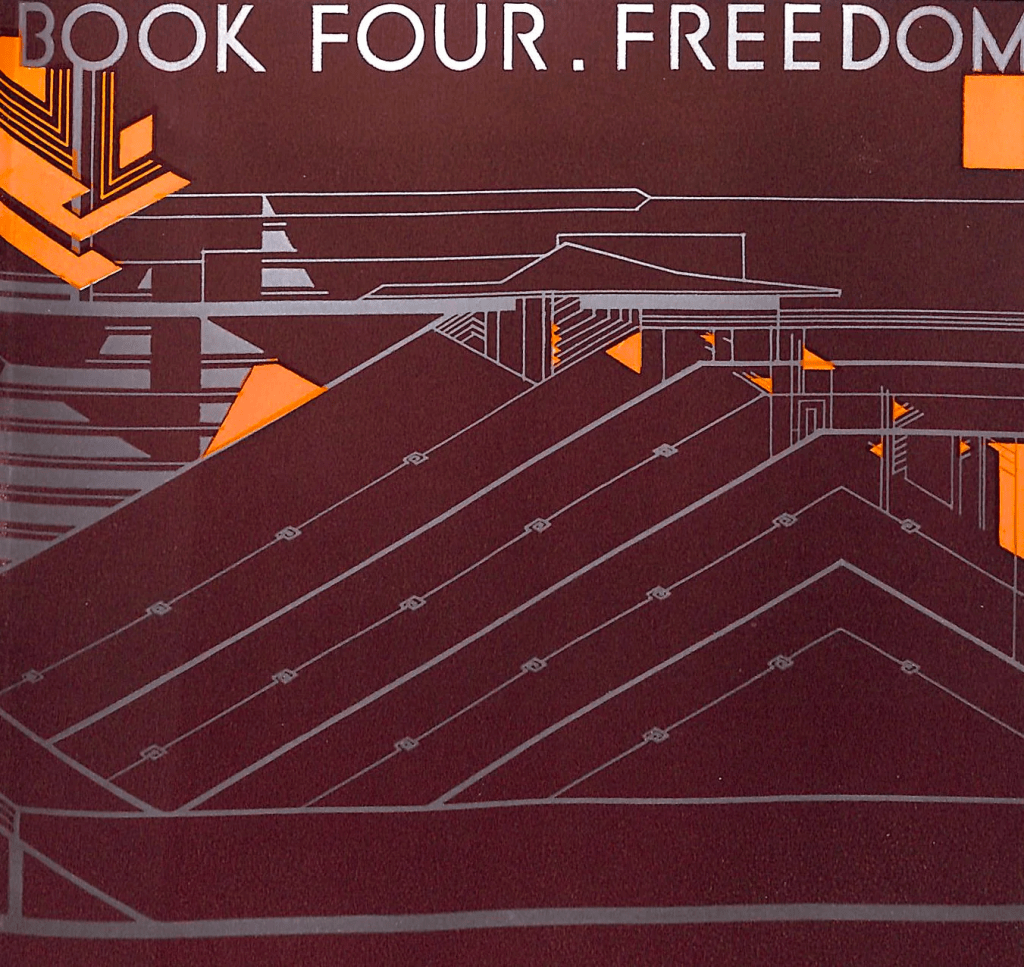
The proper use of these new resources demands that we use them all together with integrity for mankind if we are to realize the finer significances of life. The finer significance, prophesied if not realized by organic architecture. It is reasonable to believe that life in our country will be lived in full enjoyment of this new freedom of the extended horizontal line because the horizontal line now becomes the great architectural highway. The flat plane now becomes the regional field. And integral-pattern becomes “the sound of the Usonian heart.” The cover-graph of this book, I have called it “Freedom,” uses the great highway and the regional field of decentralization, uses it as a significant pattern. I see this extended horizontal line as the true earth-line of human life, indicative of freedom. Always. The broad expanded plane is the horizontal plane infinitely extended. In that lies such freedom for man on this earth as he may call his.
Originally published in Frank Lloyd Wright: An Autobiography. Book 4. Freedom
1943
 design manifestos .org